




















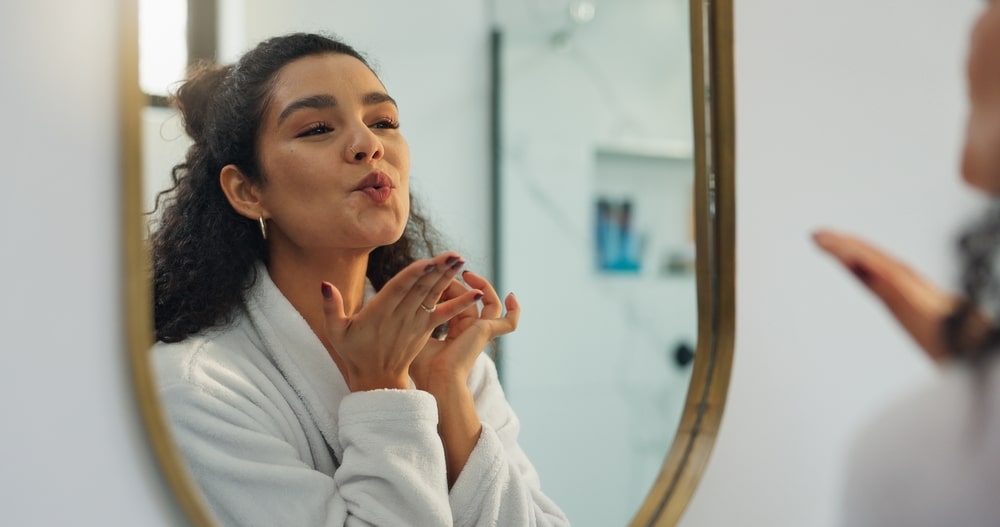
Looking back, I cringe thinking about how much I neglected my skin throughout my 20s and 30s. Honestly, I don’t think I owned so much as a drugstore moisturizer, let alone a multi-step routine or a bottle of facial sunscreen. It simply wasn’t something I gave any thought to.
My come-to-Jesus moment happened in a brewery bathroom on a summer afternoon. I’d stopped to wash my hands and caught a glimpse of myself in the mirror. Something above my lip — dirt from my bike handlebars, I assumed. I scrubbed at it with wet fingers, grateful I’d noticed before heading back out into the sunshine. But it wouldn’t budge. Swipe, swipe, swipe. Still there. Oh my god. How had I not noticed before? Years of benign neglect had finally shown up as melasma, shaped like a dirt mustache that was suddenly the only feature of my face I could think about.
Fast forward to now, at 44. I have an arsenal of well-curated products, sunscreen in every form (lotion, spray, powder) in every bag I own, and a quarterly facial appointment I look forward to more than almost anything else on my calendar.
That said, I’m also a woman on the internet, which means my algorithm fires a constant stream of products and treatments at me. Slugging. Tallow balm. Skin cycling. LED masks. Retinol before 30, never before 30, only on alternating Tuesdays. The line between actually caring for your skin and quietly harming it is thinner than the before-and-after creators want you to believe.
If you’re in your 20s or 30s, I want to save you the particular horror of a brewery bathroom mirror moment. And I don’t want you wasting time, money, or energy on things that don’t matter. So I talked with Kristyn Smith, esthetician and founder of Practise NYC, who has spent over two decades working at the intersection of clinical aesthetics and holistic skin health. She gave me the clearest framework I’ve heard for cutting through the noise.
What should your skincare routine in your 30s actually include?
The first thing Smith wants you to know is that the 10-step routines and viral skin-cycling schedules are largely a distraction. “Your skin is an organ, not a project,” she says. “If a product doesn’t serve a specific function for your unique barrier, it’s just noise.”
What does serving your barrier actually look like? For someone in their 20s with no existing routine, Smith’s list is almost aggressively short. A gentle cleanser that doesn’t strip your natural lipids, a quality moisturizer to prevent water loss, and SPF. “Everything else is an ‘extra’ until you have this foundation,” she says.
It’s a deflating answer if you’ve already built a shelf full of actives, but Smith’s reasoning holds. The most common mistake she sees in clients in their 30s is an obsession with aggressive correction — too much retinol, harsh acids, overcrowded routines — at the direct expense of their skin barrier. “The skin is resilient, so it seems fine now,” she explains. “But you are essentially borrowing from your skin’s future health.”
What actually ages your skin
Here’s the part nobody making money off your skincare routine wants you to hear. Products account for maybe 20% of how your skin ages. The rest comes down to sleep, stress management, diet, and hormones.
“You cannot ‘product’ your way out of a high-stress lifestyle or a lack of sleep,” Smith says. “I see the skin as a mirror of what is happening internally. If you are depleted, your skin will look depleted.”
This lands differently when you’re a mom in your 30s navigating real hormonal flux — postpartum, sleep-deprived, or bumping up against early perimenopause sooner than you expected. Smith says this is exactly the moment to shift your routine toward soothing and stabilizing rather than correcting. Hormonal changes make skin more reactive and more prone to melasma (yep, that’s the one). “This isn’t the time for aggressive peels,” she says. “It’s the time for hydration, Vitamin C, and gentle botanicals.”
For busy moms who want to actually build these habits, Smith recommends habit stacking. Apply your serum while the kids are in the bath. Treat a five-minute LED mask session as your reset. “It’s about making self-care feel like a necessity, not a luxury,” she says.
The SPF conversation is simpler than the internet makes it
There is perhaps no skincare topic more polluted with conflicting information right now than sunscreen. Mineral vs. chemical. Oxybenzone concerns. The wellness-adjacent crowd suggesting you actually want more sun exposure for collagen and vitamin D. I asked Smith to just tell me what she tells her clients.
“Whether you choose mineral or chemical, the best sunscreen is the one you will actually wear every single day,” she says. If you have sensitive skin or you’re pregnant, mineral is often the better bet, more soothing with fewer variables. But the priority, full stop, is protection — from UV rays, DNA damage, and the cumulative sun exposure that adds up over decades.
And what exactly are you protecting beyond that? Your collagen, mostly. “Once it’s gone, it is very hard to rebuild,” Smith says. SPF is part of it, but so is a nutrient-dense diet and avoiding what she calls pro-inflammatory habits like smoking and excessive sugar. This is where the unsexy long-game stuff lives.
On retinol, tallow, and everything your algorithm is pushing
Retinoids are treated as a near-universal recommendation for anyone over 25, but Smith’s take is more nuanced than most. “Not every skin type can handle Vitamin A,” she says, particularly people with rosacea or a compromised barrier. In those cases, she’ll often look at alternatives like bakuchiol or lower-dose retinaldehydes to get the benefits without the chronic inflammation.
Beef tallow, the ancestral skincare trend that has taken over a certain corner of the wellness internet, gets a similarly grounded response. Smith understands the appeal, but from a clinical standpoint, tallow can be comedogenic (read: pore-clogging) for a lot of people. “We have evolved to create incredibly sophisticated, bio-available formulations that mimic the skin’s natural oils without the risk of breakouts or stability issues,” she says. The appeal-to-nature argument, in other words, doesn’t automatically make something better for your face.
More broadly, when a client comes in having gone deep on a TikTok protocol, Smith redirects rather than dismisses. “A creator’s ‘holy grail’ ingredient might be a disaster for your specific skin type,” she says. The goal is to understand your own skin’s cues, not follow someone else’s digital script.
The #1 skincare habit an esthetician wants you to build now
I asked Smith what she’d want a Motherly reader to do differently after reading this. I expected SPF. I expected a product recommendation.
What I got was this: “Stop looking at your skin in a magnifying mirror. When we over-analyze every pore, we tend to over-treat. Step back, be gentle, and trust that a healthy barrier is the most beautiful thing you can wear.”
Honestly? I’ve been staring in magnifying mirrors since the brewery bathroom. I’m going to think about that one for a while.